The Cover
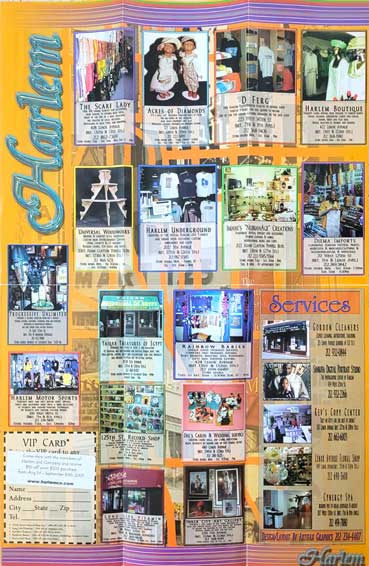
10,000-copy printed directory and shopping guide — cover design by Moor Graphix
In 2001 — before Google Business Profiles, before Yelp, before Instagram — Harlem's Black-owned businesses had no digital infrastructure. Visibility meant print. UMEZ, BRISC, and the Harlem Business Alliance commissioned Moor Graphix to build the platform they didn't have yet: a 10,000-copy shopping guide, photographed from the ground up, that put 68 local businesses in front of residents, tourists, and visitors across Manhattan.
10,000-copy printed directory and shopping guide — cover design by Moor Graphix
This directory wasn't designed by Moor Graphix. It was designed by Artifax Graphics — the studio Morrison Washington founded and operated before the name changed. Understanding that distinction matters, because it means this project is part of a 30-year arc of community-centered design, not an isolated moment.
Artifax Graphics did the same thing Moor Graphix does today: it used design as economic infrastructure. It made communities visible. It built platforms for people the mainstream market wasn't building them for. The name changed. The work didn't.
What you see in this directory is the origin of Cultural Alchemy — before it had a name.
In 2001, Harlem's small business community was thriving — but largely invisible to anyone outside of local foot traffic and word-of-mouth networks. There was no central resource connecting the neighborhood's growing ecosystem of Black-owned businesses with the residents, visitors, and tourists who were already there.
UMEZ, BRISC, and the Harlem Business Alliance understood the gap. The businesses existed. The customers existed. What was missing was the infrastructure to connect them — a credible, professional publication that would serve as a directory, a cultural ambassador, and a practical guide all at once.
Moor Graphix didn't design from a distance. The project required direct coordination with dozens of business owners across Harlem — gathering profiles, verifying information, and photographing storefronts and entrepreneurs in person. The guide was built from the neighborhood up, not from a boardroom down.
Approximately 90% of the photography in the publication was captured by Moor Graphix on location. The decision was intentional: real businesses deserved real images. Stock photography would have undermined the authenticity that made the guide valuable as both a discovery tool and a cultural document.
The design had to serve three audiences simultaneously — Harlem residents already connected to the community, first-time visitors exploring the neighborhood, and institutional partners who needed to see the economic ecosystem at a glance.
Worked directly with participating businesses across Harlem to gather profiles, contact information, service offerings, operating hours, and location data — building the directory's foundation from firsthand sources.
Photographed approximately 90% of participating businesses on-site — capturing storefronts, interiors, and entrepreneurs as they actually appeared. Every image was original, creating an authentic visual record of Harlem's commercial landscape.
Designed the multi-panel guide to balance visual storytelling, business information, community resources, and navigation tools — giving readers immediate findability by category and location without sacrificing the cultural energy of the neighborhood.
Managed print production through 10,000 copies and coordinated distribution across Harlem, uptown Manhattan, hotel districts, theater corridors, and visitor information locations — maximizing reach to both residents and tourists.
All 66 confirmed businesses from the 2001 Harlem Business Directory & Shopping Guide — documented by name, category, and address. Search or filter by section. This is the commercial census of Harlem at the turn of the century, preserved 25 years later.
When the publication launched, its primary job was practical: connect people with businesses. More than two decades later, it has become something else entirely — a primary visual record of Harlem's entrepreneurial ecosystem during one of the neighborhood's most significant periods of growth. Many of the businesses featured represent an important chapter of Harlem's economic and cultural history that might otherwise have gone undocumented.
The guide reached hotel guests before they left for the day, theater-goers between shows, and neighborhood residents who had never had a single resource to find everything their community offered. It traveled home as a souvenir. It sat on hotel concierge desks alongside Broadway programs. In the pre-Google era, physical distribution to high-traffic locations was the entire discovery funnel — and 10,000 copies made it work at scale.
Fashion, food, galleries, wellness, professional services, cultural institutions — every category of Harlem's economy under one cover, unified by a single visual language.
Moor Graphix photographed the majority of participating businesses on location. The choice to shoot original imagery rather than rely on business-submitted photos or stock ensured visual consistency across all 68 entries and created an authentic document of Harlem's storefronts and entrepreneurs exactly as they appeared in 2001.
The sponsoring organizations wanted more than a business listing. The publication was designed to communicate Harlem's energy, diversity, and entrepreneurial identity to visitors who had never explored beyond the neighborhood's most well-known destinations. Color, typography, photography, and illustration were deployed to create a guide that felt unmistakably connected to Harlem — and made visitors want to stay longer and spend locally.
Many of the 68 businesses featured represent a chapter of Harlem's economic history that might otherwise have gone unrecorded. The publication is now a primary visual document of who was building the neighborhood's economy during one of its most transformative periods — a record that compounds in value every year.
Before Google Maps, before Yelp, before Instagram Stories — visibility required design. This project is proof that a well-executed publication in the right hands can do the work of an entire digital marketing ecosystem. The channel was analog. The strategy was sound. The impact was real.
"Your heritage is your competitive moat — we forge it into visual systems that compound forever."
— Sid Washington, Moor Graphix
For the Harlem Business Directory, Cultural Alchemy meant recognizing that the neighborhood's entrepreneurial identity was already there — in its storefronts, its founders, its blocks. The job was to document it faithfully, present it beautifully, and distribute it strategically.
The publication didn't create Harlem's business community. It made it visible. And in 2001, visibility was the entire infrastructure gap. That's what design does when it's applied to community development — it doesn't invent. It reveals, amplifies, and carries forward what's already there.
A 10,000-copy printed shopping guide designed and photographed by Moor Graphix, giving 68 Black-owned Harlem businesses visibility before social media, search engines, or Google Business Profiles existed.
Full design and photography for the guide — creating a print product that served as the primary discovery tool for dozens of local businesses.
It's an early example of Moor Graphix building visibility infrastructure for underrepresented businesses — the same mission that now extends into digital brand and web work.
The channels have changed. The principle hasn't. Whether it's a publication, a website, or an AI-powered brand system — visibility still requires design. Moor Graphix builds the identity, the platform, and the infrastructure that puts your community, your organization, or your business in front of the people who need to find you.